§ Journal · May 7, 2026
Chainsaw Pitch vs. Gauge, Explained
The two specs people mix up most — what each one actually measures, why your saw cares about both, and the single mismatch that causes most failed orders.
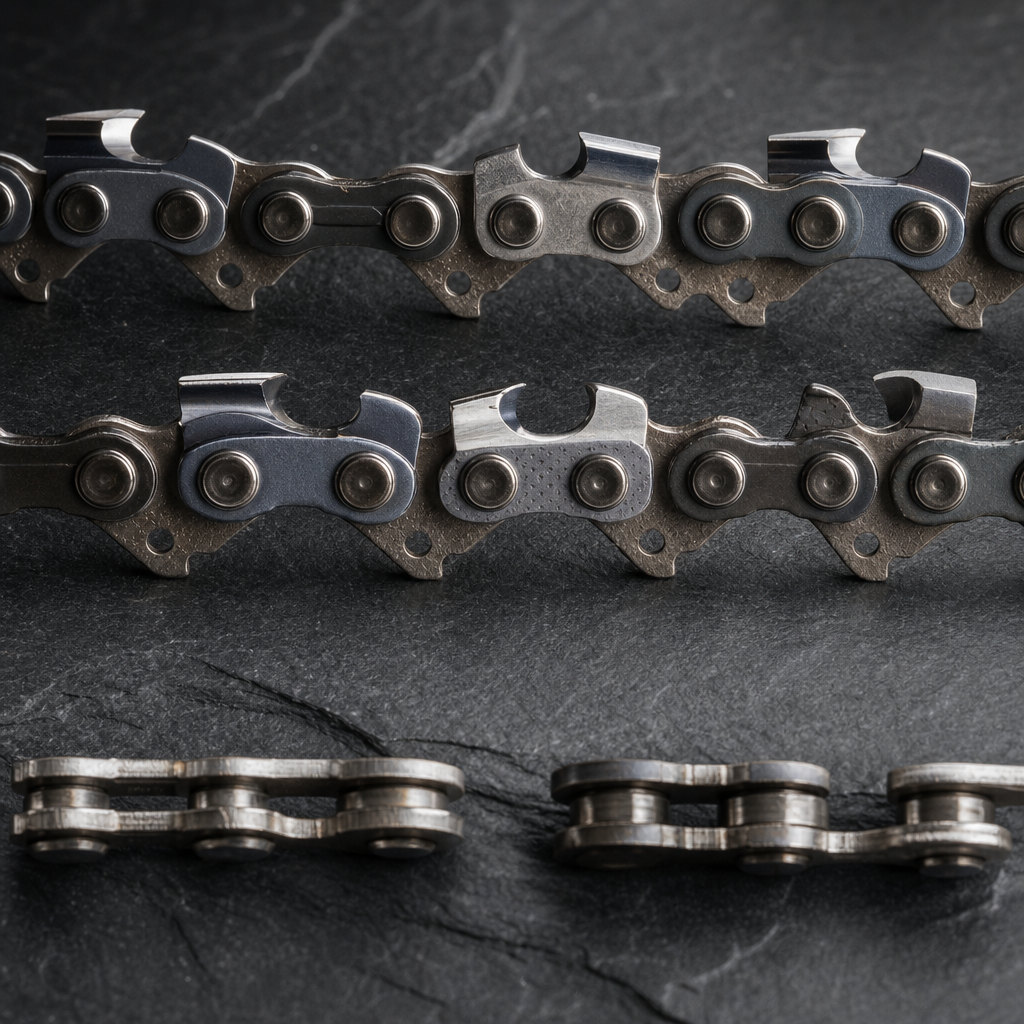
Ask ten chainsaw owners the difference between pitch and gauge and most will hesitate. They sound like jargon, but they describe two completely different physical dimensions — and mixing them up is the number-one reason a chain shows up that won’t run. Here’s the plain-English version, with the rule that keeps you out of trouble.
Pitch = how far apart the links are
Pitch is the spacing of the chain — formally, the distance between any three consecutive rivets divided by two. Think of it as how big the chain is.
Common pitches, smallest to largest:
- 1/4” — tiny carving and specialty saws.
- 3/8” Low Profile (also called Picco or LP) — the default on homeowner and battery saws.
- .325” — the workhorse pitch for mid-size gas saws (~40–50cc).
- 3/8” standard — bigger gas saws and professional use.
- .404” — large pro saws and harvesters.
The key fact: pitch must match the drive sprocket inside your saw. The sprocket’s teeth are cut for one pitch. Put the wrong-pitch chain on and the teeth and drive links don’t mesh — it skips, binds, or won’t seat.
Gauge = how thick the drive links are
Gauge is the thickness of the chain’s drive links — the tangs that sit down in the bar’s groove. It’s measured in thousandths of an inch: .043”, .050”, .058”, .063”.
The key fact: gauge must match the bar groove. Bar and chain gauge are a pair. A chain that’s too thick won’t drop into the groove at all; one that’s too thin wobbles side-to-side and can derail under load.
Why both have to be right
Here’s the trap: pitch and gauge are independent. A chain can have the correct pitch but the wrong gauge — it’ll wrap around the sprocket fine on the bench, so it looks right, but it won’t seat in the bar groove. This is the single most common mismatch we see.
So the rule is simple:
Match pitch to your sprocket. Match gauge to your bar. Both, every time.
How to find yours
Both numbers are usually stamped on the guide bar and on the chain’s drive links — see How to Read the Stamp on Your Guide Bar. If you’re replacing a chain only, copy the pitch and gauge already on the saw and add the drive-link count. If you’d rather not think about gauge at all, buy a bar-and-chain combo — the chain is pre-matched to the bar.
One more: gauge isn’t a performance upgrade
People sometimes ask whether a thicker gauge “cuts better.” It doesn’t — gauge is purely a fit dimension set by your bar. Heavier-duty saws happen to use thicker gauges because their bars are built for it, but you don’t choose gauge for cutting performance. For that, look at chain type — see Full Chisel vs. Semi-Chisel Chain.